Ayushman Card Age Limit
The Ayushman Bharat Pradhan Mantri Jan Arogya Yojana (PM-JAY) is the world’s largest government-funded health insurance scheme. It provides a safety net of Rs. 5 Lakh per year for hospital costs. If you are searching for the Ayushman card age limit, you likely want to know if you, your children, or your elderly parents qualify.
The short answer is that there is no maximum age limit to benefit from this scheme. However, how you qualify depends entirely on your age group and your family’s financial status.
Understanding The Ayushman Card Age Limit
For most people, the Ayushman card does not have a “cutoff” age. It is designed to cover entire families.
No Age Bar for Family Members
If your family is already eligible under the Socio-Economic Caste Census (SECC 2011), every single person in the house gets a card. This includes:
- Infants and Children : There is no minimum age. Even a newborn can be added to the family card.
- Adults : Men and women of all ages are covered.
- Senior Citizens : Grandparents are included in the family’s Rs. 5 Lakh shared limit.
The New 70+ Universal Rule
As of late 2024, a major update was launched called the Ayushman Vay Vandana Card. This changed the game for seniors. Now, if you are 70 years or older, you are eligible regardless of your income. You do not need to be in the “poor” category to get this specific card.
Detailed Eligibility for Different Age Groups
To rank for “Ayushman card age limit,” we must look at how the government uses age to decide who is “vulnerable.”
Rural Eligibility and Age ( The 16-59 Rule )
In village areas, the government looks for families that lack “able-bodied” adults. You are eligible if your household falls into these age-related categories:
- Missing Adult Members : Families with no members between the ages of 16 and 59. This usually covers elderly couples living alone.
- Female-Headed Households : Families led by a woman with no adult male member between 16 and 59 years.
- Landless Laborers : Families where the main income comes from manual labor, often affecting those in their middle ages who lack steady jobs.
Urban Eligibility ( Job-Based )
In cities, age is less important than your job. If you work in a “vulnerable” profession, you qualify. Common roles include:
- Domestic Workers : Maids, cooks, and cleaners.
- Street Workers : Cobblers, hawkers, and ragpickers.
- Construction : Masons, painters, and welders.
- Transport : Rickshaw pullers and delivery boys.
The Ayushman Vay Vandana Card for Seniors ( 70+ )
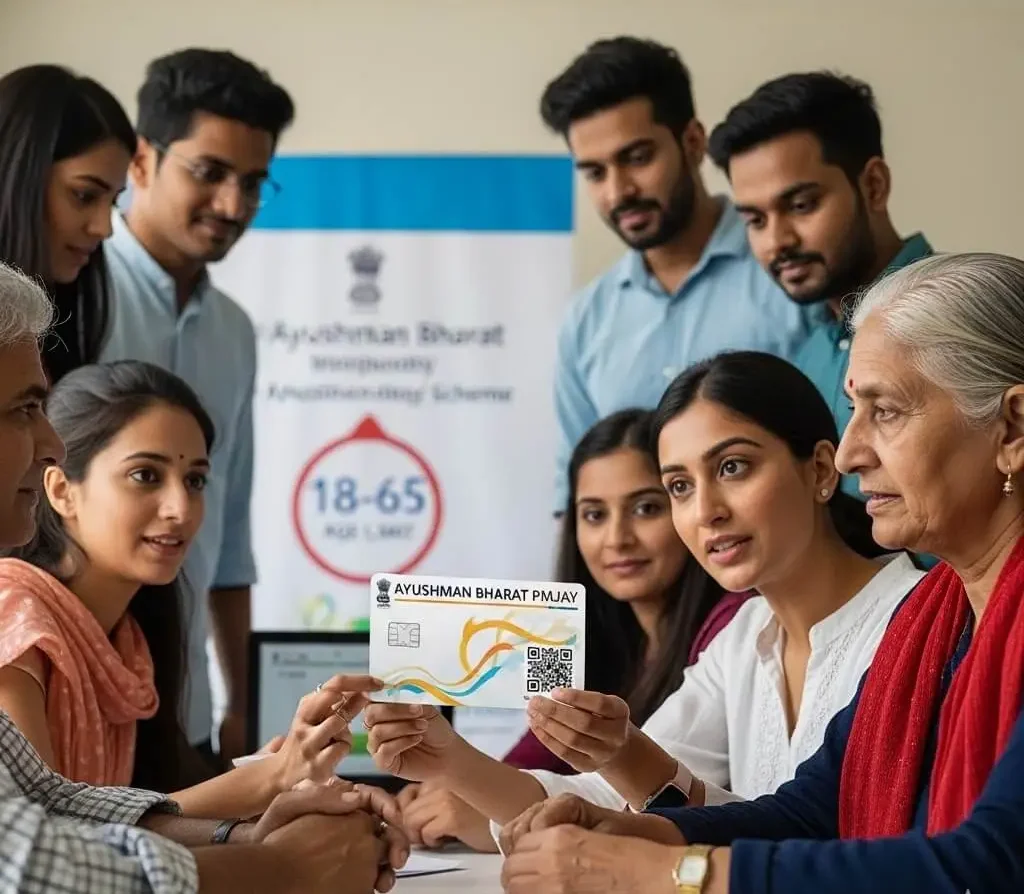
This is the most searched part of the Ayushman card age limit query. This scheme is separate from the standard family card.
Why a Separate Card ?
The government realized that seniors need more medical care. If a family of five shares Rs. 5 Lakh, one surgery for a grandparent could use up the whole limit.
- The Solution : Seniors aged 70+ get a separate Rs. 5 Lakh cover.
- Individual Benefit : This limit is just for the senior. It does not reduce the money available for the rest of the family.
If You Already Have Private Insurance
Many seniors ask: “I have a private policy, can I still get an Ayushman card?” Yes. You can hold both. The Ayushman card can act as a backup or cover treatments your private plan might skip.
Switching from CGHS or ECHS
If you are a retired government servant using CGHS (Central Government Health Scheme) or ECHS (Ex-Servicemen Contributory Health Scheme), you have a choice. You can stay with your current plan or switch to the Ayushman Bharat Vay Vandana plan. You cannot use both at the same time.
What is Covered ? ( Specialties and Procedures )
The card covers more than just a hospital bed. It covers over 1,900 medical procedures.
Critical Surgeries
Age often brings specific health issues. The card covers:
- Cardiology : Heart bypass surgeries and stents.
- Oncology : Cancer treatments, including chemotherapy and radiation.
- Neurosurgery : Brain and spine operations.
- Orthopedics : Knee and hip replacements (very common for the 70+ age group).
Pre and Post Hospital Costs
A major benefit is that you don’t just get help while in the hospital.
- 3 Days Before : Tests and consultations before you are admitted.
- 15 Days After : Medicines and follow-up checkups after you are discharged.
Step-by-Step Registration ( Aadhaar e-KYC )
Since you are looking for the Ayushman card age limit, you probably want to know how to apply once you meet the age rules. The process is now 100% digital.
Step 1: Verification
Go to the NHA Beneficiary Portal. Enter your mobile number and use the OTP to login. This proves you are a real person.
Step 2: The Search
Search for your name using your Aadhaar Number. This is the best way because Aadhaar is linked to your date of birth, proving your age automatically.
Step 3 : e-KYC
If your name appears, click on “Collect KYC.” You will need to take a live photo (if using a phone) or use a fingerprint scanner at a Common Service Center (CSC).
Step 4: Approval
Once the National Health Authority (NHA) checks your details, your card is approved. You can download the PDF and print it.
Common Exclusions : Who Cannot Get a Card ?
Even if you meet the age criteria, certain factors can disqualify you. These are “negative filters” used by the government.
- Vehicle Ownership: If you own a car or a motorized boat.
- Government Job: If any family member is a permanent government employee.
- Income: If the family earns more than Rs. 10,000 per month (Note: This does not apply to the 70+ universal scheme).
- Tax Payers: If you pay income tax.
- Property: Owning a well-built (pucca) house with more than three rooms.
Ayushman Card vs. ABHA Card
There is a lot of confusion between these two.
Ayushman Card : This is the Insurance. It pays your bills.
ABHA Card : This is a Digital Locker. It stores your medical reports and history. (Ayushman Bharat Health Account)
You need the Ayushman Card to get free treatment. The ABHA card just helps the doctor see your old records quickly.
Conclusion : Securing Your Family’s Health
The Ayushman card age limit is designed to be inclusive. While the 70+ expansion is the newest highlight, the goal remains to provide “cashless” and “paperless” healthcare to those who need it most.
By using your Aadhaar card and checking the NHA portal, you can secure a Rs. 5 Lakh cover today. This ensures that a medical emergency does not become a financial disaster for your family.