The Ultimate Guide to Ayushman Card Eligibility
For a middle-class or poor family, the primary fear isn’t just the illness, It is the hospital bill. One major surgery or a few days in a private ICU can drain a lifetime of savings. It can force families to sell land, jewellery or take high-interest loans.
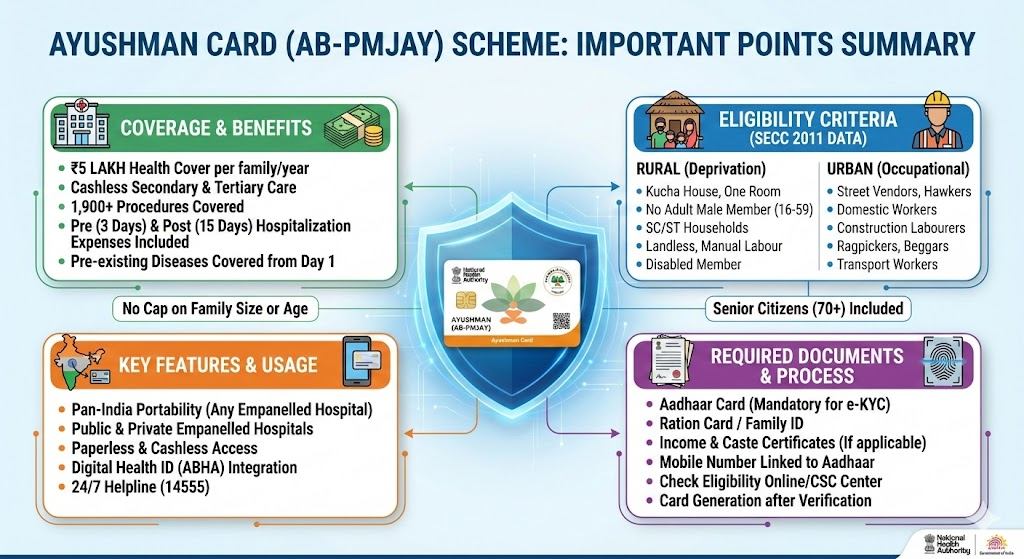
The Ayushman Bharat Pradhan Mantri Jan Arogya Yojana (PM-JAY), Launched by the Government of India, stands as the largest health assurance scheme in the world. The core benefit is a ₹5 Lakh health cover per family, per year. It includes over 1,900 medical procedures. From oncology to neurosurgery, the scheme covers almost all life-threatening conditions.
However, a massive gap exists in public awareness. You do not “apply” for eligibility. You are either “entitled” based on your socio-economic status, or you are not. If your name is on that list, you are already covered. You simply need to verify your identity to get your card. This guide ensures you claim the protection your family deserves without falling into the trap of medical debt.

Rural Eligibility Criteria SECC 2011-26 Breakdown
Most people in rural India qualify for the Ayushman Card through a specific government list. This list comes from the Socio-Economic Caste Census (SECC 2011). Think of it as a nationwide survey that identified families struggling with poverty. If the survey marked your family as “deprived,” you have an automatic right to health benefits. Knowing if you’re eligible saves time and effort. PMJAY helps millions get cashless treatment at thousands of hospitals. If you qualify, you can download your Ayushman Card easily and use it for free medical care.
Eligibility is mainly based on the Socio-Economic Caste Census (SECC) 225 data. It’s divided into rural and urban categories.
The 7 Rural Deprivation Categories ( D-1 To D-7 )
The government uses seven markers to decide who gets a card in villages. If your household falls into even one of these groups, you likely qualify.
- D1: Only One Room: Families living in a house with “Kucha” walls and a “Kucha” roof.
- D2: No Adult Member: Households with no members aged between 16 and 59.
- D3: Female-Headed: Families led by a woman with no adult male member.
- D4: Vulnerable Members: Households with disabled members and no able-bodied adults.
- D5: SC/ST Households: All families belonging to the Scheduled Castes and the Scheduled Tribes.
- D7: Landless Labourers: Families who own no land and earn money through manual physical labour.
Groups with Automatic Inclusion
Some people do not need to meet the deprivation markers. The National Health Authority includes them automatically because of their extreme living conditions.
- Destitute People: Those living on alms or without a home.
- Manual Scavengers: Individuals working in cleaning and sanitation.
- Primitive Tribal Groups: Specifically identified tribal communities.
- Legally Released Bonded Labourers: Workers freed from forced labour.
If your family fits these descriptions, your name should be in the PM-JAY beneficiary portal. You can check this using your Ration Card or Aadhaar at a local CSC centre. Most “Antyodaya Anna Yojana” (AAY) ration card holders are also part of this eligible group.
Rural Areas
In villages, families facing hardship qualify. Here are the main criteria :
- Living in a one-room house with poor walls and a roof.
- No adult member aged 16-59 years in the family
- Female-headed households with no adult male aged 16-59
- Families with a disabled member and no able-bodied adult.
- SC/ST households.
- Landless families earn mainly from manual casual labour.
- Primitive tribal groups or legally released bonded labourers.
If your family matches any of these, you likely qualify. If not, then apply for the Ayushman Card online.
Urban Areas
In cities, eligibility focuses on certain occupations common among low-income workers. Eligible jobs include :
- Ragpickers and garbage collectors.
- Beggars, domestic workers, and home-based artisans.
- Street vendors, hawkers, cobblers, and other street service providers.
- Construction workers, plumbers, masons, labourers, painters, welders, security guards.
- Sanitation workers, gardeners, and sweepers.
- Tailors, handicraft workers.
- Drivers, conductors, helpers, cart pullers, or rickshaw pullers.
- Shop workers, waiters, assistants in small shops.
- Electricians, mechanics, repair workers, and assemblers.
- Washers and watchmen.
If your main job is one of these, your family may be covered. If not, then Check ayushman card status.
The Revolution: Senior Citizens (70+ Age Group)
A major shift happened in September 2024. The Union Cabinet expanded the Ayushman Bharat PM-JAY scheme. Now, every Indian citizen aged 70 or above qualifies for free health insurance.
Before this update, eligibility depended on your income or job. That barrier is gone for seniors. Your wealth or social status no longer matters. If you are 70 years old, you are eligible. Since September 2024, every Indian aged 70 or above gets free health coverage under PMJAY.
- This is separate, even if your family is already covered; seniors get an extra ₹5 lakh.
- No income check needed.
- They receive a special Ayushman Vay Vandana Card.
Ayushman Vaya Vandana Card
Seniors in this age group receive a special card. It is called the Ayushman Vaya Vandana Card. This card is distinct from the standard yellow or blue cards. It represents a dedicated promise of care for the elderly.
How the ₹5 Lakh Top-up Works
Many seniors already live in families covered by PM-JAY. If your family already has a ₹5 lakh cover, you do not have to share it. You get an additional, private top-up of ₹5 lakh just for yourself. This money is for your use only. The rest of the family keeps their original ₹5 lakh limit.
Choices for Retired Officials
Seniors using CGHS (Central Government Health Scheme) or ECHS (Ex-Servicemen Contributory Health Scheme) have a choice. You can stay with your current scheme or switch to Ayushman Bharat. You cannot use both at the same time. If you have private health insurance, you can still get the Vaya Vandana card.
- Grandparents’ Corner Registration is simple for seniors. You only need your Aadhaar card.
- The process uses “Face Auth” technology.
- This means you don’t need to worry about blurry fingerprints.
- Just a quick photo verifies your identity.
How to Check Ayushman Card Eligibility?
It’s simple and free :
- Visit the official website: https://beneficiary.nha.gov.in/
- Click on “Am I Eligible”
- Enter your mobile number or Aadhaar details
- Verify with OTP
- See if your name appears in the beneficiary list
You can also call the helpline: 14555 or visit a nearby Common Service Centre (CSC).
What is the Ayushman Card Scheme?
The Ayushman Card hospital is a health card from the government. It gives free hospital care to needy people. Launched in 2018, it’s also called PM-JAY or Pradhan Mantri Jan Arogya Yojana. Under this, families get up to ₹5 lakh coverage for secondary and tertiary care. This means surgeries, medicines, and hospital stays are free at empanelled hospitals.
Why is it important? Many families can’t afford big medical bills. This scheme stops them from selling land or going into debt. Over 50 crore people are eligible, but only if they meet the criteria.
Did you know? The scheme now includes more people, such as senior citizens over 70 years old. Updates in 2024 made it even better.
Ayushman Card Eligibility Basics
To get an Ayushman Card, you must be from a poor or low-income family. The government uses a list called SECC 2011 to pick families. This stands for Socio-Economic Caste Census. For villages, it’s about deprivation, like no good house or job. For cities, it’s about low-wage jobs like rickshaw pulling.
Key rule: One family gets one card. It covers all members automatically. But wait, eligibility isn’t just about money. It’s about your living conditions and work. Let’s dive deeper. There is no strict upper age limit. Even old people qualify if their family does.
For kids? Newborns to elders, all covered under the family card.
Special note: From September 2024, all seniors above 70 will get a separate card, even if their family is rich. This adds 6 crore more people. What about the age of the main earner? In rural areas, if no ayushman card age limit the family qualifies.
What does it offer?
- Free health insurance up to ₹5 lakh per family per year
- Covers secondary and tertiary treatments
- Works in government and private empanelled hospitals
- Completely cashless treatment
- No premium, no registration fee
What expenses are covered?
- Hospital admission
- Surgeries
- Medicines
- ICU charges
- Diagnostic tests
- Pre and post-hospitalisation expenses.
Rural Family Eligibility
Most Indians live in villages. So, rural rules are key. The government looks at the 2011 census data. If your family shows “deprivation,” you qualify.
Here are the main points :
- Single Room House: If your home has only one room, with kuccha walls (mud or grass) and a thatch roof. This shows poverty.
- No Adult Male Worker: Family without a man aged 16-59 who works. This means widows or disabled families.
- Disabled Member in SC/ST Family: Scheduled Caste or Tribe families with one disabled person, but no able adult to earn.
- Landless Labourers: No land, and main income from daily wage work, like farming help or construction.
Urban Family Eligibility
In urban areas, the rules for Ayushman Card eligibility change. While rural selection looks at housing, city selection focuses on your profession. The government identifies eligible families based on 11 specific occupational groups. If the main earner in your family works in these sectors, you likely qualify for the ₹5 lakh health cover.
City life is different. Urban eligibility focuses on jobs. If you do low-pay work, you may qualify. No need for SECC here—it’s occupation-based.
11 Eligible Urban Job Categories
The National Health Authority targets workers in the informal economy. These are people who keep our cities running but often lack formal health insurance.
- Domestic Workers: This includes housemaids, cooks, and cleaners working in private homes.
- Street Vendors: People selling goods on footpaths, hawkers, and small-time traders.
- Construction Workers: Skilled and unskilled labour like masons, plumbers, painters, and welders.
- Sanitation Workers: This group covers ragpickers, sweepers, and garbage collectors.
- Transport Workers: Drivers and conductors of rickshaws, autos, and taxis.
- Home-based Workers: Tailors, artisans, and individuals running tiny cottage industries from home.
- Shop Workers: Assistants at small shops, peons in offices, and delivery partners.
- Service Workers: Waiters at dhabas or restaurants and washers (dhobis).
- Security Guards: Unarmed guards working for small agencies or apartments.
- Electricians and Mechanics: Repair workers and assemblers in small workshops.
How to Verify Urban Eligibility?
If your job falls under these categories, the government has likely already listed you. You can check your status on the PM-JAY portal using your mobile number. Most families in these groups also hold a Priority Household (PHH) or Antyodaya Ration Card. These documents are the strongest proof for your Ayushman Card verification.
Unlike rural areas, urban lists are often updated through local municipal surveys. If your profession is on this list but your name is missing, visit a nearby Common Service Centre (CSC). They can help you check if your Ration Card is linked to the PM-JAY database.
Urban vs Rural: Quick Comparison
| Aspect | Rural | Urban |
| 1 . Basis | SECC Deprivation | Occupation |
| 2 . Examples | Landless farmers | Rickshaw pullers |
| 3 . Check Method | Family ID or Ration Card | Self-declaration + docs |
Special Groups (Asha’s, Anganwadi, Frontline etc )
A massive update in 2026 brought a new group into the Ayushman Bharat fold. The government now provides full health cover to all ASHA workers, Anganwadi Workers, and Helpers. This decision recognises their tireless service to the nation. Previously, many of these frontline workers lacked personal health security. Now, they and their families receive the same ₹5 lakh annual insurance as other beneficiaries.
Why is this inclusion vital?
ASHA and Anganwadi workers are the primary link between the government and rural families. They manage maternal health, vaccinations, and nutrition at the village level. Protecting them ensures the entire healthcare system remains strong. This move removes the financial burden of surgery or hospitalisation for these workers. It allows them to focus on community care without fearing personal medical debt.
Eligibility for Families
This benefit is not just for the individual worker. It extends to the entire family. The National Health Authority uses the existing database of the Ministry of Women and Child Development. If you are a registered worker, your Aadhaar is your primary key to this benefit. You can download your specific Ayushman Card using the official mobile app or at any empanelled hospital.
The process for these workers is streamlined. You do not need to fall under the SECC 2011 deprivation list. Your active service status makes you eligible. This is a “Right to Health” gift for the defenders of India’s grassroots health.
Who is Not Eligible?
The Ayushman Bharat PM-JAY program targets the most vulnerable citizens. Because of this, certain groups do not qualify for the ₹5 lakh health cover. Knowing these rules saves you time and prevents rejected applications.
Common Reasons for Exclusion
The National Health Authority uses specific filters to identify families with higher financial stability. If your household meets any of the following criteria, you are generally not eligible for the standard card.
- Income Tax Payers: Any family member who pays income tax is automatically excluded.
- Government Employees: Households with a regular, non-contractual government employee cannot join.
- Vehicle Ownership: Families owning a motorised two-wheeler, three-wheeler, or four-wheeler do not qualify.
- Professional Equipment: Ownership of a mechanised fishing boat or heavy farm machinery like tractors is a disqualifier.
- Large Land Owners: Families owning more than five acres of irrigated land are ineligible.
- High Monthly Income: If any family member earns more than ₹10,000 per month (under original SECC rules), the family is excluded.
- Business Owners: People running registered non-agricultural enterprises with the government.
[Image showing icons of cars, tractors, and tax forms as Ayushman Card exclusions]
The Exception to the Rule
The 2024 update created a massive exception. If you are 70 years or older, these exclusions do not apply to you personally. Even if you are a retired government official or a taxpayer, you can still get the Ayushman Vaya Vandana Card. This specific card ignores family wealth to ensure every senior has health security.
For everyone else, the government relies on the SECC database and the current ration card status. If your financial status has improved significantly since 2011, your name may have been removed from the beneficiary list. Transparency about these rules is why this scheme remains sustainable for those who need it most.
Step-by-Step: How to Check Eligibility Online?
Checking your name on the official list is the first step toward securing your health cover. You can do this from home using a smartphone or by visiting a local help desk. Here is the exact process to verify your status.
Using Official Beneficiary Portal
The National Health Authority provides a simple website for self-verification. Follow these steps to check your family’s eligibility:
- Visit the official portal at beneficiary.nha.gov.in.
- Enter your active mobile number on the login page.
- Choose the “Beneficiary” option and click “Verify” to receive an OTP.
- Enter the 6-digit OTP sent to your phone.
- Select your State and the scheme (PMJAY).
- Search by your Aadhaar Number, Ration Card (Family ID), or Name.
If your family is eligible, a list of members will appear on your screen.
The Ayushman App Method
For mobile users, the “Ayushman App” is the most convenient tool. You can download it from the Google Play Store.
- Open the app and login using your mobile number and OTP.
- Use the “Search by Aadhaar” feature for the fastest results.
- The app allows you to perform e-KYC instantly using Face Authentication.
- Once verified, you can download your digital Ayushman Card directly to your phone.
Offline Verification Options
If you are not comfortable with websites, you can seek human assistance. Two reliable options exist:
- Common Service Centres (CSC): Visit any nearby CSC or “Digital Seva” Kendra. The operator will check the database using your Ration Card. They can also help with thumbprint verification.
- Ayushman Mitra: Every empanelled government and private hospital has a dedicated “Ayushman Mitra.” They sit at the help desk near the entrance. They will check your eligibility for free and guide you through the admission process.
Checking your eligibility costs nothing. Avoid paying private agents who claim they can “add” your name for a fee. Only the official NHA database determines your entitlement.
Required Documents for Ayushman Card Eligibility
Once you confirm your eligibility, you need the right documents to generate your actual card. Having these ready prevents multiple trips to the centre. Most rejections happen because of mismatched names or missing family links.
The Primary Identity Proof
The Aadhaar Card is the most important document for the Ayushman Bharat scheme. It serves as your primary identity and address proof. Your Aadhaar must be linked to an active mobile number. This link allows you to receive the OTP required for verification. If your Aadhaar details are old, update them at an Aadhaar Kendra first.
Proving Family Linkage
The government must verify that you belong to an eligible household. For this, you need a Ration Card or a Family ID (like the Parivar Pehchan Patra in some states). The Ration Card is vital because it lists all family members. This document ensures that every person in your home gets individual access to the ₹5 lakh cover.
Category of Income Certificates
In specific cases, the “Ayushman Mitra” might ask for category proof. This applies if your eligibility depends on being part of a Scheduled Caste (SC) or Scheduled Tribe (ST). A Caste Certificate helps confirm your spot on the SECC list. Similarly, an Income Certificate might be necessary if your eligibility is based on low-income thresholds in your specific state.
Understand ekyc in Simple Terms
The most common term you will hear is e-KYC. Do not let the technical name confuse you. It simply means “Electronic Know Your Customer.” In plain English, it is a digital way to prove you are who you say you are.
You complete e-KYC using a digital fingerprint scan or a Face Scan via the Ayushman App. This process matches your live physical features with the data stored in the Aadhaar database. Once the system matches your face or thumbprint, your Ayushman Card is approved instantly. It is a paperless, secure, and fast way to claim your health rights.
State-Wise Ayushman Card Eligibility
Uttar Pradesh (UP) Eligibility :
- Over 5 crore covered. Rural focus on BPL families.
- Migrant workers from other states qualify, too.
Delhi :
- Delhi has its own scheme, but Ayushman works for migrants.
- Check via the Delhi govt portal + national.
Bihar :
- Bihar added 1.5 crore in 2025.
- Eligibility same, but more CSCs.
Haryana :
- Focus on construction workers.
Karnataka :
- Includes fisherfolk.
Myths About Ayushman Card Eligibility
- Myth 1: Only SC/ST qualify.
- Fact: All poor castes do.
- Fact: All poor castes do.
- Myth 2: The age limit is 70 only.
- Fact: Family-based, no upper limit.
- Fact: Family-based, no upper limit.
- Myth 3: Need to pay for a card.
- Fact: Free!
Benefits
- Free treatment at 27,000+ hospitals.
- Covers 1,900 procedures—like cancer, heart surgery.
- No cap on family members.
- Cashless, no out-of-pocket.
Ayushman Card Eligibility
For Disabled Persons :
- If disabled and family poor, auto-eligible.
- Blind, mentally ill, or locomotor disability.
- Disabled persons in poor families are auto eligible
- Includes blindness, mental illness, and physical disability
- Covers rehabilitation and surgeries
For Women and Maternity :
- Normal delivery to C-section free.
- Even if not fully eligible, women in the workforce may get.
- Pregnancy care covered
- Normal delivery and C-section free
- Special focus on maternal health
How to Apply Ayushman Card?
Offline Method
- Visit CSC or PM Jan Arogya Kendra
- Show documents
- Get an e-card instantly
Online Method
- Visit the official PM-JAY portal
- Verify eligibility
- Download e-card
Troubleshooting: My Name is Not on List, Now What?
Finding your name missing from the PM-JAY list is a common hurdle. However, this does not always mean you are ineligible. Technical errors or life changes often cause these gaps. You can fix most of these issues through the official portal or a mobile app.
Adding New Family Members
If your family is already on the list, you can add new members easily. This usually applies to a new bride or a newborn baby. You do not need a new survey for this.
- Log in to the Ayushman App or portal.
- Select the “Add Member” option under your family ID.
- Upload the marriage certificate for a bride or the birth certificate for a child.
- Complete the e-KYC using the new member’s Aadhaar card.
Fixing Aadhaar Name Mismatch
Spelling errors are the biggest reason for verification failure. If your name on the Ration Card differs from your Aadhaar, the system will reject you. You must ensure both documents match perfectly. Use the “Aadhaar Correction” service to fix your name or date of birth first. Once updated, the Ayushman system will sync the data automatically within a few days.
Official Grievance Redressal
If you believe you meet all criteria but remain excluded, use the formal grievance channel. The National Health Authority provides a dedicated helpline for this.
- National Helpline Number: Call 14555 for immediate assistance.
- Grievance Portal: Visit cgms.nha.gov.in to lodge a formal complaint online.
- Track Status: You will receive a reference number to track your request.
Do not fall for scams promising to “insert” names into the SECC 2011 list. That database is fixed. Only the “Add Member” feature for existing families or the new 70+ senior citizen category allows for new entries. Use the official channels to protect your data and money.
Expert Tips to Speed Up Your Approval
Getting your Ayushman Card approved does not have to be a slow process. Most delays happen because of simple technical errors or a lack of information. These expert tips help you bypass common hurdles and secure your health cover quickly.
Keep Your Aadhaar Mobile Number Active
The entire PM-JAY system relies on secure verification. When you apply, the National Health Authority sends an OTP to the mobile number linked with your Aadhaar. If this number is inactive, you cannot complete the e-KYC process. Visit a nearby Aadhaar Seva Kendra to update your current number if it has changed. An active link ensures your card is generated in minutes rather than days.
Use Face Auth for Blurry Fingerprints
Many labourers and senior citizens struggle with fingerprint scanners at CSC centres. Physical work or age can fade fingerprints, leading to repeated failures. To solve this, download the official Ayushman App. It features a “Face Auth” (Face Authentication) tool. This technology uses your phone’s camera to verify your identity. It is faster, more reliable, and works even when biometric machines fail.
Visit Private Empanelled Hospitals
Most people crowd government offices or local centres to check their status. Instead, go to a large private hospital that is “empanelled” (registered) under PM-JAY. These hospitals have a dedicated Ayushman Help Desk managed by an “Ayushman Mitra.” Because these desks are less crowded, the staff can spend more time fixing your data errors. They have a direct interest in approving your card so you can start your treatment.
Final Verification Check
Before you leave the enrollment centre, double-check your digital profile. Ensure your name matches your Ration Card exactly. Small typos in the database can block your hospital admission later. A clean record now means a cashless experience when you need it most.
Author & Researcher
Mohit
My name is Mohit. I am a digital researcher, content strategist, and public welfare writer. I create detailed guides about government health schemes and online beneficiary services. I am known for explaining information related to Ayushman Bharat – Pradhan Mantri Jan Arogya Yojana (PM-JAY) in a simple and practical way. My work is mainly for people who want to understand topics like the Ayushman Card, eligibility check, beneficiary portal login, hospital list, and the online application process.
Professional Background
I have worked for several years on digital information platforms. My focus has been on government welfare schemes, health insurance programs, and online citizen services. My goal is to provide accurate and updated information so that people can fully benefit from government schemes.
My main research focus is the Ayushman Bharat scheme, which is one of the largest public health insurance programs in India. Under this scheme, eligible families can get cashless hospital treatment of up to ₹5 lakh. It covers both secondary and tertiary healthcare. I ( Mohit ) study official portals, policy documents, and healthcare resources, then create simplified guides for users.
Expertise Areas
Articles I have mainly covered:
- Ayushman Card online application process
- PMJAY beneficiary portal login guide
- Ayushman Card eligibility criteria
- Ayushman Card status check
- Hospital list and treatment coverage
- Government health scheme awareness
My content is designed so that even first-time users can easily follow step-by-step instructions.
Mission
My mission is simple: to make government health schemes easy to understand for everyone. Many people miss out on benefits because they lack the right information. I aim to share accurate and updated details through digital platforms so more people can benefit.
Content Philosophy
I follow three main principles in this content:
- Accuracy: Based on official sources and policy information
- Clarity: Simple and practical explanations
- Accessibility: Easy-to-follow guides, even for mobile users
My goal is not just to provide information, but to help people actually get real benefits.
Editorial Standards
Before publishing, My articles go through strict checks:
- Reference to official government sources
- Updated scheme rules and eligibility verification
- Clear step-by-step instructions
- Content structure based on user needs
This approach ensures that readers get reliable and practical information.
Work on AyushmanCard.org
I works as the primary author and researcher at AyushmanCard.org. My focus includes:
- Ayushman Bharat scheme awareness
- Beneficiary portal guidance
I continue to create helpful content so people can easily understand and use government health services.